The Nevis Gaming License has emerged as a structured, practical option for operators seeking to establish or expand in the iGaming sector.
Rather than focusing solely on speed or accessibility, Nevis provides a clear regulatory framework that allows businesses to operate with a defined process and predictable requirements.
For many operators, the key question is not whether the license can be obtained, but how the process works in practice and what is required to complete it efficiently.
We assist clients throughout this process, from initial structuring to final license approval, ensuring each stage is handled clearly and in a coordinated manner.
Is the Nevis Gaming License Difficult to Obtain?
No — the Nevis Gaming License is not inherently difficult to obtain. The process is structured and follows a clearly defined sequence. When the application is properly prepared, operators can complete the licensing process efficiently and without unnecessary delays.
The complexity typically arises only when documentation is incomplete or the business model is not clearly presented.
Overview of the Licensing Process
The licensing process in Nevis follows a logical sequence. Each stage builds on the previous one, ensuring that the business is properly structured before it becomes operational.
In summary, the process involves:
- Incorporation of a Nevis entity
- Preparation of the licensing application
- Completion of due diligence checks
- Submission and regulatory review
- Issuance of the license
- Operational setup
While straightforward in structure, the outcome depends largely on how well each stage is prepared.
How Long Does It Take to Obtain a Nevis Gaming License?
In most cases, obtaining a Nevis Gaming License takes approximately 8 to 12 weeks, depending on the completeness of the application and the responsiveness during the regulatory review process.
A well-prepared application can significantly reduce delays and improve overall efficiency.
Positioning of Nevis Compared to Other Jurisdictions
Nevis is best understood within the broader context of available licensing options.
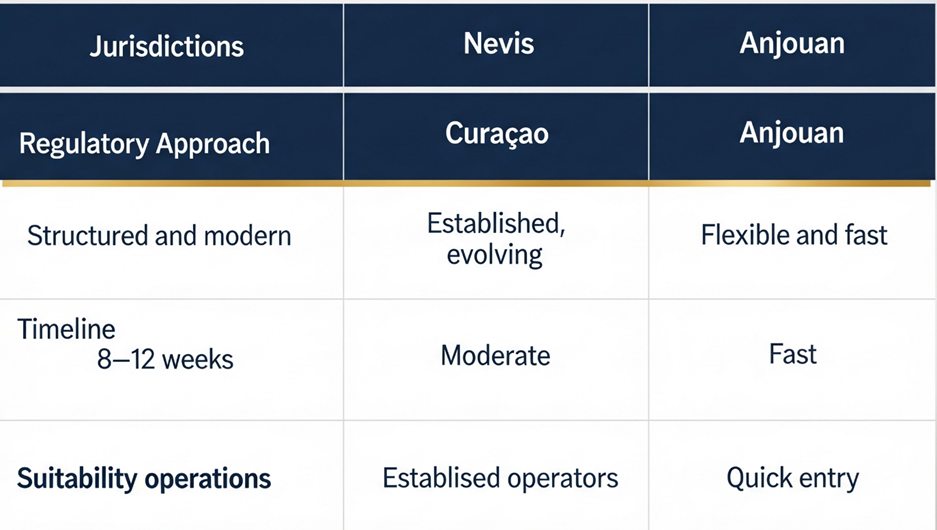
Nevis occupies a balanced position, offering greater structure than fast-entry jurisdictions while remaining more flexible than highly regulated environments.
What Is Required to Apply for a Nevis Gaming License?
To apply for a Nevis Gaming License, operators must establish a local company, prepare a complete licensing application, and undergo due diligence checks. The process includes corporate structuring, submission of compliance documentation, and regulatory review.
Each of these elements must be aligned to meet the authority’s requirements.
Step 1: Company Incorporation
The first step is the incorporation of a Nevis company, as the license is issued exclusively to locally registered entities.
At this stage, the corporate structure is defined, including shareholders, directors, and Ultimate Beneficial Owners. Each individual involved is subject to background checks under the applicable “fit and proper” requirements.
A properly structured entity at this stage facilitates the subsequent licensing process.
Step 2: Preparation of the Application
Following incorporation, the application file is prepared.
This stage involves presenting a complete and coherent picture of the business. The regulator assesses not only the submitted documentation but also whether the proposed operations are clearly defined and compliant.
The application typically includes:
- Business plan and operational description
- Documentation relating to ownership and source of funds
- Terms and conditions and internal policies
- Compliance framework, including AML and KYC procedures
Where applicable, additional technical elements such as game provider agreements or certifications may be required.
In practice, this is the stage where a structured approach makes the greatest difference. Applications prepared with consistency and clear operational logic tend to move through the review process with fewer interruptions.
Step 3: Due Diligence and Background Checks
All relevant parties undergo due diligence as part of the application process.
This includes verification of identity, financial background, and professional standing. The purpose of this stage is to ensure that the business meets regulatory standards and operates with transparency.
Incomplete or inconsistent documentation at this stage is one of the most common causes of delay.
Step 4: Regulatory Review
Once submitted, the application is reviewed by the authority.
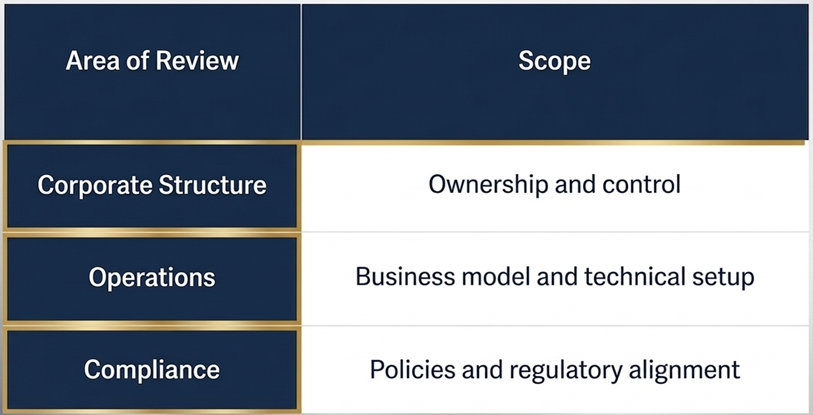
The evaluation focuses on three principal areas :
The authority may request clarifications during this stage, which form part of the standard review process.
Step 5: Issuance of the License
Upon successful completion of the review, the license is granted.
The Nevis Gaming License is issued for a period of one year and may be renewed annually. It may cover both B2C and B2B activities and allows for scalable operations through multiple domains.
Step 6: Operational Setup
Following approval, the business proceeds to operational implementation.
This includes the integration of payment solutions, finalization of the gaming platform, and implementation of compliance measures, including geo-blocking of restricted jurisdictions.
Timeline
The overall process typically takes between 8 and 12 weeks, depending on the completeness of the application and responsiveness during the review phase.
A Structured Process — When Handled Correctly
While the licensing process may initially appear detailed, in practice it follows a clear sequence.
When each stage is prepared properly, the process becomes predictable rather than complex. This is particularly important for operators planning a defined launch timeline, where delays can impact broader business objectives.
Documentation Requirements
The documentation required will vary depending on the structure of the business. In general, the application includes:
- Identification and verification documents
- Evidence of source of funds and ownership
- Corporate documentation
- Business plan
- Compliance policies
All documentation must meet certification standards and, where necessary, be translated into English.
Common Challenges
Although the process is structured, challenges may arise if preparation is insufficient.
Typical issues include:
- incomplete documentation
- unclear business models
- inadequate compliance policies
These can generally be avoided through proper planning and structuring from the outset.
Frequently Asked Questions
Is the process complex?
The process is structured rather than complex. Its efficiency depends on preparation.
Is physical presence required?
No, the process can be completed remotely.
Can multiple domains be operated?
Yes, multiple domains may be included within the license structure.
What causes delays?
Delays are typically related to incomplete or inconsistent documentation.
Conclusion
The Nevis Gaming License offers a structured pathway for businesses entering the iGaming sector.
Its framework provides clarity and predictability, allowing operators to establish their activities with a defined process and regulatory alignment.
Next Step
For businesses considering this option, the key factor is not the regulation itself, but how the process is structured from the outset.
A well-prepared application reduces uncertainty, improves efficiency, and allows the business to move forward with clarity.
📩 Contact our team to discuss your case.